O critério de Kelly e a roleta
O critério de Kelly diz a um apostador com vantagem quanto deve apostar. Para a roleta dá uma resposta clara: nada.

Aposta de Kelly = vantagem / odds. Com uma vantagem negativa, a fórmula devolve uma fracção negativa, o que significa não apostar. O critério continua a ser útil para perceber porque é que os jogadores de viés dimensionavam as apostas como o faziam, e porque é que todos os outros devem dimensioná-las pelo orçamento.
O critério
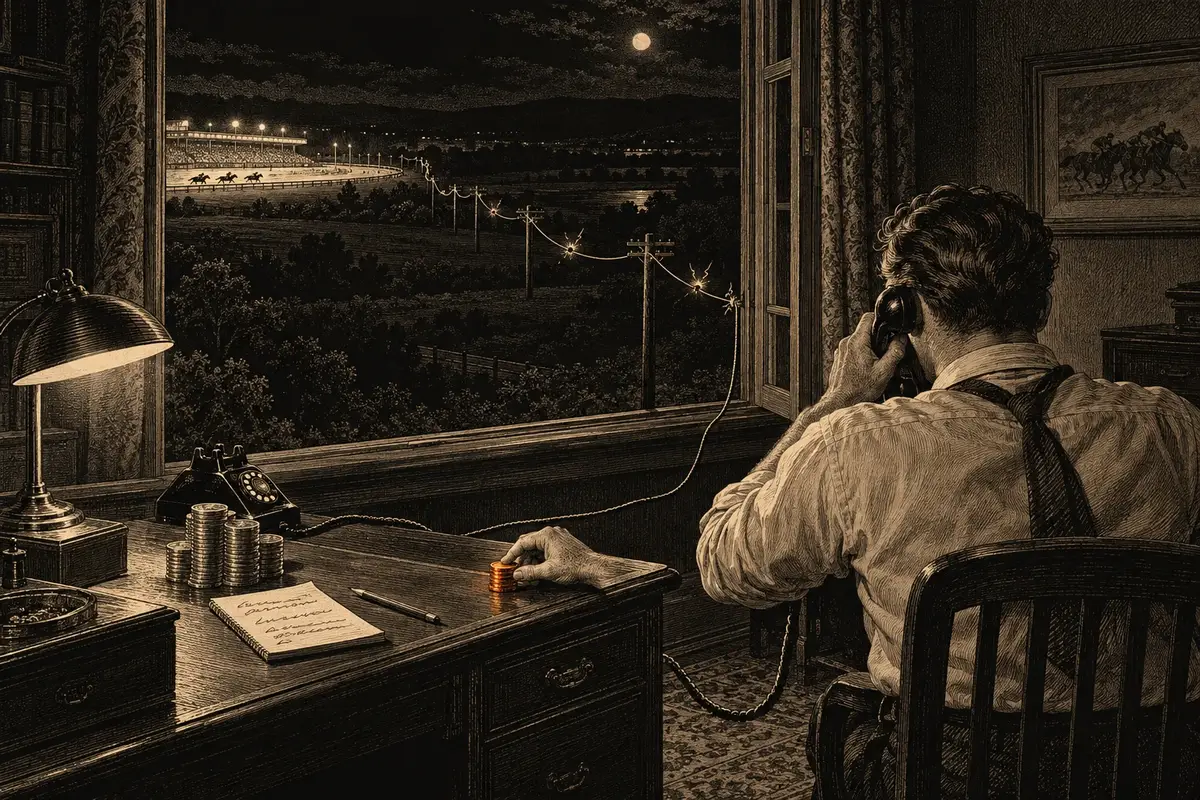
John Kelly (1956) asked how a gambler with a known edge should size bets to maximize long-run growth of the bankrolldinheiroBancaO montante total reservado para jogar. A gestão de banca consiste em decidir que parte dela arriscar por aposta e por sessão.Ler tudo →. The answer, for a bet paying b to 1 with win probabilitymatemáticaProbabilidadeMedida da possibilidade de um resultado, de 0 a 1 ou de 0% a 100%. Um número: 1/37 = 2,70%.Ler tudo → p and loss probability q = 1 − p, is to stake the fraction f* = (bp − q) / b of the bankroll. Positive f* means bet that fraction; zero or negative means do not bet. Kelly worked at Bell Labs, and his paper, “A new interpretation of information rate”, set the problem in Claude Shannon’s theory of information: a gambler who gets tips over a noisy line, at fair odds, can grow the bankroll at best at the rate the line carries information. This is a growth objective under a probability model, not a promise to finish ahead after a particular number of bets. A spending limit, finite deadline or payoutdinheiroPagamentoO que uma aposta vencedora devolve, indicado como “X para 1” além da aposta devolvida.Ler tudo → cap changes the decision problem.
O critério de Kelly aplicado à roleta
For redapostaVermelhoAposta simples nos 18 números vermelhos. Em francês: rouge.Ler tudo →: b = 1, p = 18/37, q = 19/37; f* = (18/37 − 19/37)/1 = −1/37. For a straight upapostaPlenoUm único número, paga 35:1.Ler tudo →: b = 35, p = 1/37, q = 36/37; f* = (35/37 − 36/37)/35 = −1/1295. Every standard bet gives a negative Kelly fraction, because every bet has a negative edge, and the growth-optimal stake is zero. Kelly betting on roulette is a formal way of saying what the house-edge page says: no positive stake maximizes expected logarithmic growth when the bet has negative expectation. A particular session can still end in profit. La partageregraLa partageRegra francesa: quando sai o zero, é devolvida metade de uma aposta simples. Reduz para metade a vantagem da casa nessas apostas, para 1,35%.Ler tudo → needs a separate three-outcome calculation: a win, a full loss or a half-loss on zerorodaZeroO único compartimento verde, que nenhuma aposta simples, dúzia ou coluna cobre; a origem da vantagem da casa. Também: zero único, 0.Ler tudo →. Its expected log growth also falls as the stake increases from zero.
Onde Kelly se aplicou
Suppose a pocketequipamentoCompartimentoUma das 37 divisões numeradas do rotor. Também: célula, alvéolo.Ler tudo → really has a stable, known probability of 1 in 30 and pays 35 to 1. The Kelly fraction is 0.57%: about $57 from a $10,000 bankroll. Under independent spinsmatemáticaLançamentos independentesCada lançamento tem as mesmas probabilidades, independentemente do historial. A base de todos os cálculos deste site.Ler tudo → and exact fractional staking, the geometric growth factor over 1,000 spins is about 1.7. Expected bankroll grows faster because rare large wins pull up the average. These are model calculations, not evidence that any named historical player used Kelly or achieved this result.
Típico e médio
The gap between the typical bankroll and the average one is wide. Take a pocket that hits 1 time in 25, a hypothetical edge of 44% per unitdinheiroUnidadeA aposta base em que um sistema ou um jogador trabalha. As progressões são descritas em unidades para se aplicarem a qualquer mesa.Ler tudo → staked. Kelly stakes 1.26% of the bankroll on it. After 1,000 spins the typical bankroll has grown about 11.5 times, while the average, pulled up by a few very lucky runs, has grown about 249 times. Betting more than Kelly raises the average and lowers the typical result: at twice the Kelly stake the typical bankroll only doubles, and by two and a half times the Kelly stake it shrinks, although every bet still carries a 44% edge. In this example, half-Kelly retains about 78% of the expected log growth. This fraction depends on the probabilities and payout.
Quando a vantagem é um palpite
Kelly uses the true probabilities, but a player usually has only estimates. Selecting the busiest pocket from a past record creates a selection problem: even a fair wheel has a busiest pocket. Its observed rate can overstate its future probability. Choosing the stake from that same record compounds the error. An independent follow-up sample helps test a proposed bias (see How to Detect Roulette Wheel Bias). Reducing the calculated fraction reduces exposure, but cannot turn a false edge into a real one.
Pessoas com vantagem
Haghani and Dewey (2016) studied 61 participants given $25 and 30 minutes to bet on a simulated coin with a disclosed 60% chance of heads. The payout cap was $250; its value was revealed when a proposed winning bet would reach it. Their reported 21% success category included balances of at least $200, while the 28% “bust” category meant less than $2, not necessarily zero. Eighteen participants bet their entire balance on one flip. The uncapped Kelly fraction is 20%, but the cap and deadline change the optimization problem. The experiment illustrates how stake choices matter even with a known advantage; it does not establish one best strategy for every objective.
O que usar em vez disso
Sem vantagem, o dimensionamento é uma questão de orçamento, não de crescimento: a aposta é o que está disposto a gastar por lançamento, calculado a partir do orçamento por hora e do ritmo da mesa (página de gestão de banca). O contributo de Kelly para o jogador comum é a clareza da sua resposta: zero. Tudo o que apostar acima de zero é o preço de jogar, escolhido por si, não optimizado por qualquer fórmula.
Uma nota sobre o Kelly fraccionário e a “gestão de dinheiro”
Betting a fixed percentage of the current bankroll is proportional staking: the stake rises after wins and falls after losses. Flat bettingestratégiaAposta fixaApostar o mesmo montante em todos os lançamentos. A referência com a qual todas as progressões são comparadas.Ler tudo → instead keeps the cash stake fixed. Neither creates an edge on ordinary roulette. With infinitely divisible stakes and a fraction below 100%, proportional staking never reaches exactly zero in finitely many losses, but the balance can become arbitrarily small. Real table minimums can prevent further play much sooner. The growth-optimal fraction remains zero.
Fórmula
Perguntas
Only when the actual probabilities, payouts and conditions give a credible positive advantage. Standard bets on an unbiased wheel have no such advantage.
Using half the calculated fraction reduces exposure to errors in the estimated edge. The familiar three-quarters-growth rule is an approximation for small advantages, not a universal identity. It does not protect against an edge that does not exist.
Não. Kelly optimiza o crescimento quando há vantagem. A gestão de banca controla a despesa quando não há.
Matemática por prazer
Tente primeiro resolvê-los sozinho. Cada solução está escondida; abra-a quando estiver pronto.
Suppose a hypothetical bet on one number has a known 44% edge under standard payoutsdinheiroPagamentoO que uma aposta vencedora devolve, indicado como “X para 1” além da aposta devolvida.Ler tudo → and independent spinsmatemáticaLançamentos independentesCada lançamento tem as mesmas probabilidades, independentemente do historial. A base de todos os cálculos deste site.Ler tudo →. Kelly gives a 1.26% bankrolldinheiroBancaO montante total reservado para jogar. A gestão de banca consiste em decidir que parte dela arriscar por aposta e por sessão.Ler tudo → fraction. What if the same 44% edge came on one bet spread over five neighboring numbers?
Mostrar a solução
Resposta Kelly manda então apostar 7,1% da banca, e a banca cresce quase seis vezes mais depressa: cerca de 1,25 milhões de vezes em 1000 apostas, contra cerca de 11,5 vezes.
A straight upapostaPlenoUm único número, paga 35:1.Ler tudo → with a 44% edge wins with chance 0.04, since 36 × 0.04 = 1.44. Kelly’s stake is the edge divided by the odds: 0.44/35 = 1.26%. The typical growth per bet is 0.04 × ln(1 + 35 × 0.0126) + 0.96 × ln(1 − 0.0126) ≈ 0.00244, so 1,000 bets multiply the bankroll by about e^2.44 ≈ 11.5.
Spread one stake over five numbers and the bet wins with chance 0.20 and pays 36/5 for 1, that is 6.2 to 1: still a 44% edge, since 0.2 × 7.2 = 1.44. Kelly’s stake becomes 0.44/6.2 = 7.10%, and the growth per bet 0.01404, about 5.75 times as much. Over 1,000 bets that is e^14.04, about 1.25 million.
The edge is the same; the swings are smaller. A bet that wins one time in five has a larger growth-optimal fraction in this model, although losses can still reduce the bankroll severely. This comparison assumes the same known edge for both bets; actual predictions need independent evidence.
Assume two numbers are adjacent on the betting layoutequipamentoPanoA grelha de apostas impressa na mesa. Também: mesa, feltro, tapete.Ler tudo → and each has a stable, known probabilitymatemáticaProbabilidadeMedida da possibilidade de um resultado, de 0 a 1 ou de 0% a 100%. Um número: 1/37 = 2,70%.Ler tudo → of 1 in 25 on independent spins. Compare a splitapostaCavaloDois números adjacentes, paga 17:1.Ler tudo → between them at 17 to 1 with equal straight-up stakes on the two numbers. How much does Kelly say, and how fast does the bankroll grow compared with one such pocketequipamentoCompartimentoUma das 37 divisões numeradas do rotor. Também: célula, alvéolo.Ler tudo →?
Mostrar a solução
Resposta Não faz diferença: 2,59% da banca no cavalo, ou 1,29% em cada número. A banca típica cresce cerca de 155 vezes em 1000 lançamentos, contra 11,5 vezes com um só compartimento.
The split wins with probability 2/25 = 0.08 and pays 17 to 1, so it returns 18 × 0.08 = 1.44 per unitdinheiroUnidadeA aposta base em que um sistema ou um jogador trabalha. As progressões são descritas em unidades para se aplicarem a qualquer mesa.Ler tudo → staked: an edge of 44%, the same as one biased pocket. Kelly’s stake is the edge divided by the odds: 0.44/17 = 2.59%.
Two straight-up bets of 1.29% each give exactly the same results. When either number comes up, one chipdinheiroFichaUma peça que representa um montante fixo, colocada no pano para fazer uma aposta. Também: cheque.Ler tudo → wins 35 to 1 and the other is lost, a net of 34 × 1.29% = 44% of the bankroll, as the split pays; when neither does, both are lost.
The growth per spin is 0.00505, against 0.00244 for one pocket, so over 1,000 spins the typical bankroll grows e^5.046 ≈ 155 times rather than e^2.44 ≈ 11.5 times. The geometric growth factor is larger because the combined bet wins more often at the same 44% edge. It is a model result, not a guaranteed bankroll.
Pausa cómica
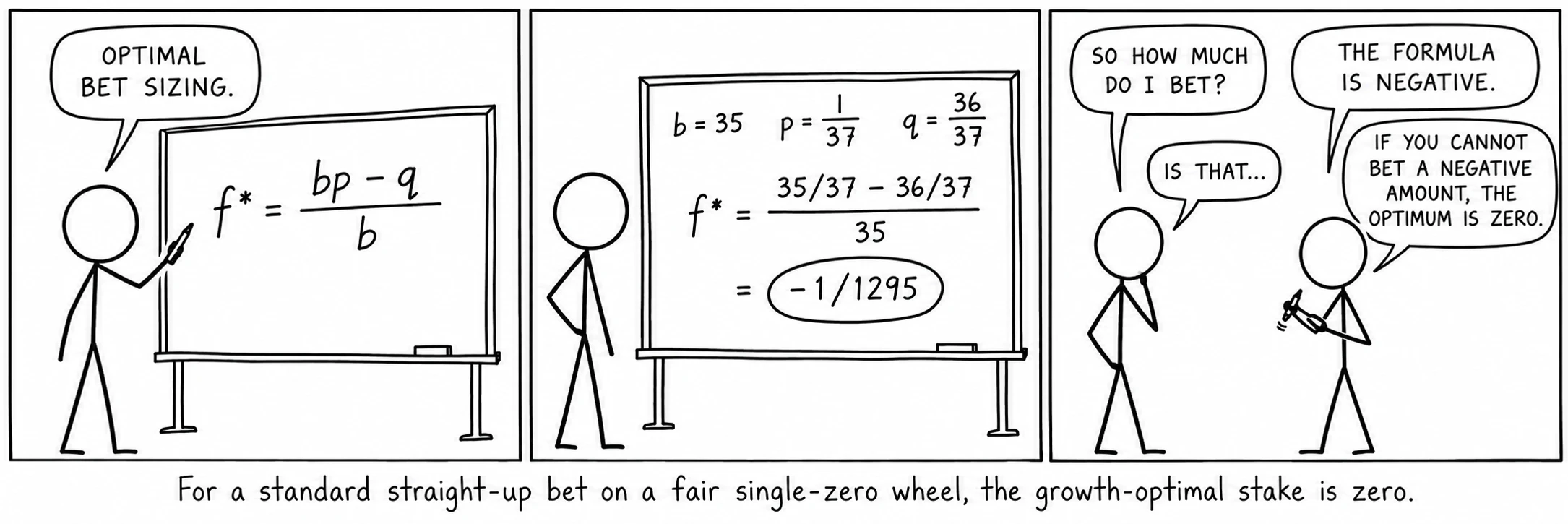
A aposta de roleta óptima para o crescimento é um número que todos já conhecem.
Fontes
- Kelly, J. L. “A new interpretation of information rate.”
- Breiman, L. “Optimal gambling systems for favorable games.”
- Thorp, E. O. “Optimal gambling systems for favorable games.”
- Thorp, E. O. The Mathematics of Gambling.
- Epstein, R. A. The Theory of Gambling and Statistical Logic, 2nd ed.
- Taylor, D. G. Games, Gambling, and Probability: An Introduction to Mathematics, 2nd ed.
- Ethier, S. N. The Doctrine of Chances: Probabilistic Aspects of Gambling.
- Haghani, V. & Dewey, R. “Rational decision-making under uncertainty: observed betting patterns on a biased coin.”